


Echinacea (Coneflower)
Add A Wow Factor To Your Garden With Beautiful Echinacea
Echinaceas are a must-have for any garden. Whether you’re an avid gardener or just beginning your green thumb journey. Their vibrant colours, long-lasting blooms, and unique appearance bring a dramatic pop of colour and texture to your outdoor space. DutchGrown’s collection allows you to mix and match varieties to suit your garden’s style, from purples and pinks to yellows, oranges, and whites.
Discover our collection and start planning your Echinacea garden.
Showing 25 - 26 in 26 items
From Purple Coneflower To Yellow Coneflower: The Key Characteristics
Echinacea, commonly known as Coneflower, belongs to the daisy family (Asteraceae) and takes its name from the Greek word for "spiny one". Native to the eastern and central United States, these resilient perennials carry large, daisy like flowers around a spiny, cone shaped centre, on sturdy stems that grow between 60 and 150 cm tall, with lower varieties too.
Coneflowers bloom from mid summer until the autumn frosts, bringing months of colour to the garden, and they make excellent cut flowers. They are loved by butterflies and bees, and if you leave some faded blooms standing, the seed heads feed birds, goldfinches especially, through autumn and winter.
Which coneflower is for you?
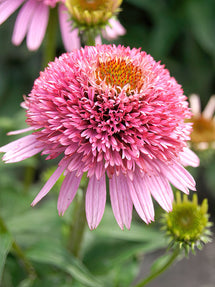
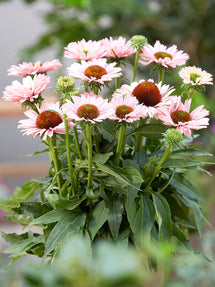
 Classic pinksThe coneflower as most of us picture it: a bold central cone ringed with single petals. Pretty Parasols lets its petals hang like a parasol, Sunseeker Salmon is a soft salmon pink, Playful Meadow Mama is a neat raspberry pink, and Double Decker carries a curious second tier of petals on top.
 Double pompomsHere the cone becomes a full, fluffy pompom. Choose from Raspberry Truffle, Blackberry Truffle, Southern Belle, Strawberry and Cream, the deep violet Blueberry Cheesecake and the creamy white Cherry Fluff.
 Yellow and orangeSunshine colours for the summer border. Yellow Passion, Lemon Drop and Yellow Rainbow cover the yellows, Marmalade and Irresistible bring warm orange, while Fiery Meadow Mamma and Rainbow Marcella mix red, gold, pink and peach.
 Green and whiteCool, unusual shades that flower arrangers love. Green Twister shades from lime green to lilac, Green Jewel is fresh green throughout, Honey Dew is a soft greenish white, and Virgin is a clean white with a green cone.
 Small and neatShort, sturdy coneflowers for pots and the front of the border. Tweety stays under 30 cm, while Mini Belle and Butterfly Kisses make compact mounds of bright pink doubles.
 Ready made mixesCannot choose? The Everblooming Coneflower Mix gives you a blend of colours that flower for months, and the Indian Summer Mix combines coneflowers with heleniums for a wildlife garden in warm, late summer tones.
Echinacea Pretty Parasols from bare root to full flower in an English garden, with the bees to prove it.
Planting and flowering through the year
Plant the bare roots in spring. Coneflowers bloom from July to September, often into October, and the seed heads stand through winter.
Coneflower Varieties: From Echinacea Purpurea to Echinacea Pallida
There are nine recognised species of Echinacea, including the Tennessee Coneflower and Echinacea laevigata, the smooth purple Coneflower. Three species are the ones most often grown in gardens, and between them they are the parents of the modern varieties in our collection:
- Echinacea purpurea, the purple Coneflower, has broad petals around a striking orange cone. It is easy to grow and richly coloured, which makes it ideal for beginners and experienced gardeners alike.
- Echinacea angustifolia, the narrow leaved Coneflower, has slender foliage and shorter stems, giving a more compact, refined plant for beds and borders.
- Echinacea pallida has long, narrow, drooping petals, usually in pale pink, for a softer and more graceful look.
Want to know more? Read everything you need to know about Echinacea.
How To Grow Echinacea Plants For Maximum Effect
Growing Coneflower plants is easier than you might think, and with a little care at the start you can enjoy years of beautiful blooms.
Where coneflowers grow best
Choose a spot in full sun with well drained soil. Coneflowers are prairie plants, so they take summer heat and dry spells in their stride once established. The one thing they dislike is sitting wet in winter, so on heavy clay work in some grit before planting.
A thin layer of compost and a mulch over the soil helps hold moisture, encourages the roots to establish and keeps weeds down.
How to plant the bare roots
- Plant in spring, once the last frost has passed.
- Dig a hole and set the bare root so its top sits level with the soil surface.
- Fill in around it and firm the soil gently.
- Space plants 30 to 90 cm apart, depending on their mature size.
- Water thoroughly, and keep watering in dry spells through the first season.
Our tip: for bushier plants and later flowers, cut the stems back by about 30 cm when growth is well under way in late spring. The plants respond with more compact, branching growth and flower into early autumn. Cut back only a few stems on each plant and you get the best of both: flowers at different heights, opening in succession over a longer season. For more advice, and for growing coneflowers in pots and containers, follow our guide How to Grow Echinacea.
DutchGrown, specialists in flower bulbs and perennials since 1882Year after year
Coneflowers are hardy across the UK and come back every summer. Leave the seed heads standing over winter: they look handsome rimed with frost and feed the birds. Cut everything back to the ground in early spring, before new growth appears.
Clumps can be lifted and divided in early spring or autumn if they become crowded, though coneflowers are happy left undisturbed for years.
Good companions
Coneflowers belong with other sun loving, drought tolerant perennials. They are lovely with the flat heads of Achillea, the shaggy flowers of Monarda and tall Phlox, all in flower at the same time.
For autumn, add Sedum, and weave ornamental grasses, salvias or lavender between them for a relaxed, prairie style planting.
Where To Buy Echinacea: Find Coneflowers For Sale At DutchGrown
If you are looking for the best quality Echinacea roots, you are in the right place. Our collection ranges from multicoloured varieties such as Echinacea Green Twister to elegant types such as Echinacea Yellow Passion, and if you cannot choose, our Coneflower mix Indian Summer is an excellent place to start. Order your premium Coneflower bare roots now for spring planting.
Dispatched locally from London, with the quality and experience of a family business established in 1882.
Frequently Asked Questions About Coneflower Plants
When to plant coneflowers?
The best time to plant coneflowers is in spring, once the last frost has passed and the soil has begun to warm up. Planting in early spring gives the roots time to establish before the heat of summer, so the plants can settle in and flower well from early to late summer, depending on the variety.
Are coneflowers deer resistant?
Largely, yes. Deer tend to leave coneflowers alone, put off by the rough leaves and the spiny cones, which makes Echinacea a sound choice for gardens where deer are regular visitors. No plant is completely deer proof when food is scarce, but coneflowers are rarely their first choice.
What to plant with Echinacea?
Echinacea looks its best with other sun lovers that cope with dry spells. Salvias, lavender and ornamental grasses are classic partners, and in our own range Achillea, Sedum, Monarda and Phlox all flower alongside it and enjoy the same conditions.
How tall do Echinacea plants grow?
Most Echinacea plants grow between 60 and 150 cm, depending on the variety and the growing conditions. Echinacea Pretty Parasols, for example, reaches 70 to 100 cm, while the compact Echinacea Tweety stays under 30 cm. By choosing the right variety you can use coneflowers anywhere from the front of a border or a pot to the middle of a large bed.
Do coneflowers come back every year?
Yes. Coneflowers are tough, hardy perennials that return every year with very little care. In colder parts of the country, a light mulch in late autumn protects the roots. You can cut the stems back after the first frost, or leave the seed heads standing for the birds and tidy up in early spring. If you want to divide or move plants, early spring or autumn is the time.
When do coneflowers flower?
In the UK, coneflowers flower from mid summer into autumn, usually from July to September and often on into October. Removing the first faded flowers encourages more to follow.
Are coneflowers good for bees and butterflies?
Very. The open flowers are rich in nectar and pollen and are visited constantly by bees and butterflies through summer. Later, the seed heads feed birds, goldfinches especially, so it is worth leaving some standing over winter.
Can I grow Echinacea in pots?
Yes. Choose a compact variety, a pot at least 30 cm wide with good drainage holes and a free draining compost, and stand it in full sun. Water regularly in summer, as pots dry out much faster than open ground.